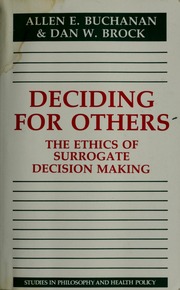
This book is the most comprehensive treatment available of one of the most urgent--and yet in some respects most neglected--problems in bioethics: decisionmaking for incompetents. Part I develops a general theory for making treatment and care decisions for patients who are not competent to decide fo
Good Organizational Decisions: Ethical Decision-Making Toolkit for Leaders and Policy Makers
β Scribed by Bashir Jiwani
- Publisher
- Springer
- Year
- 2020
- Tongue
- English
- Leaves
- 108
- Series
- SpringerBriefs in Ethics
- Category
- Library
No coin nor oath required. For personal study only.
β¦ Synopsis
This book is both a workbook and process guide for making ethical system-level decisions. It is of great use to any individual or team that is looking for support in making an ethically-justified system-level decision β that is, a decision that will impact people in more than one or two individual situations. Traditionally, when people think of ethics in the context of policy, what comes to mind is identification of key principles relevant to the work. Ethics analysis of the policy then explores what these principles mean and how they are balanced in the policy. The conventional approach only considers formal policies as worthy of ethics analysis, and the method of analysis leaves a number of key ethically significant dimensions of the system-level decision process unaddressed. The approach in this book assists decision leaders or teams to make better decisions and realize the benefits of quality, legitimacy, and compliance - and most important, greater integrity for all concerned. Applicable to almost any context, this resource has been effectively utilized in organizations that range from health care to civil society.
β¦ Table of Contents
Introduction
Welcome to this Resource
In a Nutshell
Table of Contents
How to Use this Resource
Whatβs Different About this Approach
Frequently Asked Questions
Facilitating Conversations
ELEMENTS OF GOOD FACILITATION
HELPING A GROUP GET THE FACTS STRAIGHT
HELPING A GROUP ARTICULATE VALUES
SUPPORTING EMOTIONS
WORDS DESCRIBING DIFFERENT EMOTIONS
Step 1 Establish the Team
WORKSHEET
Step 2 Communication Strategy
WORKSHEET
Notes:
Step 3 Select the Key Question(s)
TIPS FOR SUCCESS
WORKSHEET
Notes:
Step 4 Look at the Evidence
TIPS FOR SUCCESS
WORKSHEET
Step 5 Consider Whatβs Important
TIPS FOR SUCCESS
TECHNIQUES FOR PRIORITIZING VALUES
WORKSHEET
Step 5b Synthesize Values (optional)
WORKSHEET
Step 6 Brainstorm Options
WORKSHEET
Step 7 Analyze Options
WORKSHEET
Notes:
Step 8 The Preliminary Decision
WORKSHEET
Notes:
Step 9 Engagement
TIPS FOR SUCCESS
WORKSHEET
Notes:
Step 10 The Decision
WORKSHEET
Step 11 Education Plan
WORKSHEET
Notes:
Step 12 Downstream Support Plan
WORKSHEET
Notes:
Step 13 Evaluation & Sustainability Plan
TIPS FOR SUCCESS
WORKSHEET
Notes:
Step 14 Ongoing Feedback Plan
WORKSHEET
Your Feedback is Important!
Notes:
Step 15 Implement the Decision
TIPS FOR SUCCESS
WORKSHEET
Notes:
Appendix A Sample Meeting Schedule
Appendix B Important Values to Consider
Acknowledgements
π SIMILAR VOLUMES
Includes bibliographical references (p. 387-412) and index
1. Ethics in Organizations -- 2. Ethics and the Challenge of Ethical Behavior in Organizations -- 3. The Nature of Decision Making in Organizations -- 4. The Relationship between Groupthink and Unethical Behavior in Organizations -- 5. Leadership and Unethical Behavior in Action -- 6. Countering Une
Are you involved in making decisions in court, a tribunal, or another formal decision-making environment? This book gives guidance in the skills required to reach and deliver well-structured judicial decisions. The authors (all of whom have extensive judicial and quasi-judicial experience across Eng
Organizations provide mind-boggling compensations to their leaders as compared to an average employee. Is it because they work more? Just like the saying βwe are the decisions we makeβ, the very existence of an organization depends on the decisions its leaders make! Decision-making is not just a pro
<p><p>Prescriptive Bayesian decision making has reached a high level of maturity and is well-supported algorithmically. However, experimental data shows that real decision makers choose such Bayes-optimal decisions surprisingly infrequently, often making decisions that are badly sub-optimal. So prev