
📂 Library
📅 2001
🏛 Washington, DC : American Psychological Associatio
🌐 English
xxii, 368 pages ; 26 cm
✍ Scribed by Shane S. Bush
No coin nor oath required. For personal study only.
This is an up-to-date guide to ethical decision making in the daily practice of clinical neuropsychology that includes a Continuing Education (CE) component administered by the American Academy of Clinical Neuropsychology. Emphasizing positive ethics, the book models a decision-making process by which practitioners can successfully resolve common ethical challenges. It is organized around the Ethical Standards of the American Psychological Association, each of which is systematically applied to neuropsychology and brought to life through extensive case studies that show the ethical decision-making model in action. (The book contains a total of 27 cases.) The book reflects the most recent published ethical, professional, and legal requirements and guidelines and synthesizes the latest research. Graduate students, those preparing for board certification, and even experienced clinical neuropsychologists will find much here that is useful; it will be especially valuable neuropsychologists who do forensic work. Those who wish to earn CE credit after reading the book are directed to a test on the American Academy of Clinical Neuropsychology website.
📜 SIMILAR VOLUMES
xxii, 368 pages ; 26 cm
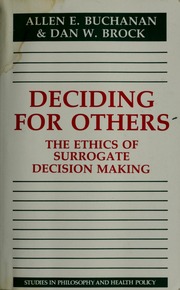
This book is the most comprehensive treatment available of one of the most urgent--and yet in some respects most neglected--problems in bioethics: decisionmaking for incompetents. Part I develops a general theory for making treatment and care decisions for patients who are not competent to decide fo
Includes bibliographical references (p. 387-412) and index
Part of the Wiley Series in Clinical Geropsychology, Changes in Decision-Making Capacity in Older Adults: Assessment and Intervention helps to familiarize you with the legal and social contexts for decision making in potentially impaired individuals. Editors Sara Qualls and Michael Smyer have brough
Rewritten and redesigned for 2002, this comprehensive primer examines the hows — and whys — of making choices that are ethical. With realistic examples and a step-by-step decision-making model, this easy-to-read booklet is ideal for the individual reader — or as a training resource for any organ